Beginner's mind
The uncertainties faced in this very early stage of the quantum technology industry offers few clear answers to questions about when useful applications will emerge or even what those applications will be. What is required is an outlook that can navigate a path with scant guidance.
There's an ongoing debate about when quantum computing will make a difference in society and the economy. The standard answers fall into predictable camps: it's imminent, it's just around the corner, or it's ten to twenty years away. NVIDIA CEO Jensen Huang's original estimate in December 2024 was "fifteen to twenty years," which he modulated later to something more optimistic. The boosters — particularly publicly traded quantum companies that need to convince the Street — insist they're already providing value, or are just about to.
The reality is that very little revenue is being generated directly from quantum technologies today. But it's not a twenty-year outlook either. Gaining a nuanced sense of the accurate timing requires the adoption of shoshin, a Japanese Zen Buddhist concept that means approaching a subject without preconceptions.
The Threshold
Within the next five years, a hardware device will ship that cannot be classically simulated — something on the order of fifty fault-tolerant qubits, creating a Hilbert space whose states would require 2^50 classical bits to represent. Past that threshold, everything that runs on the device is, by definition, quantum advantage. I laid out this argument in more detail in A New Chapter, along with why I think the timeline between a technique's invention and its industrial application — the Monte Carlo problem, as I call it — is something we have more control over than people realize.
The short version: Stanislaw Ulam invented the Monte Carlo method in 1948 as a workaround for physics calculations. It took thirty years for anyone to apply it to financial portfolio optimization. We can foreshorten that gap for quantum — but the honest answer is still: we don't know what we don't know.
Bigger Than Computing
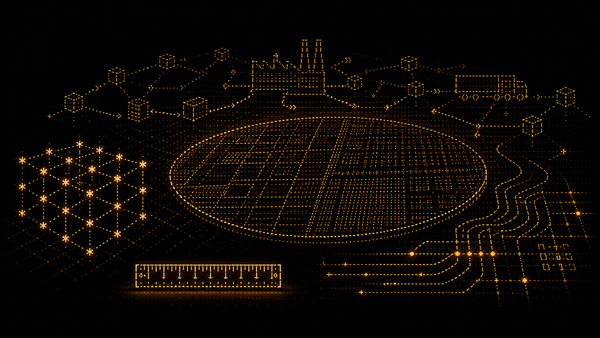
The standard framing — when will quantum computing matter? — is too narrow. The broader story is about quantum technologies driving regional investment in quantum ecosystems writ large: supply chain vendors, innovative materials that may have ultimately classical applications but are derived through quantum engineering, single-photon emitters, nitrogen-vacancy centers as ultra-sensitive detectors.
From that perspective, what Illinois, Colorado, and other states are investing in represents the beginnings of a new industrial infrastructure that takes precision and advanced manufacturing to the quantum scale.
In some sense, this is the only path forward. TSMC and ASML are already using extreme ultraviolet lithography to produce chip features at the sub-two-nanometer scale. Below two nanometers, one can credibly argue that everything is quantum mechanical. The path forward for classical computing leads directly into quantum, whether the information being processed is quantum or classical.
Dana Anderson said on our podcast that in ten years, any company not operating at the quantum limit won't be competitive. That points to something extremely broad and profound — repercussions across every industry. If the CHIPS and Science Act was partly an attempt to get the horse back in the barn and bring semiconductor manufacturing back to the United States, well — it's always easier to feed and nurture a baby horse already in the barn than to entice a wild one back in from the field. The premise the United States is starting to adopt is that quantum technologies are at the heart of a reindustrialization of the country, and a new engine for economic and social growth.
The Home Field Advantage
We do have some things we know. The radical beginnings of the whole field are embodied in Feynman's famous comment at the Endicott House conference in 1981: nature isn't classical. If you want to simulate nature, you're going to need a quantum computer.
What that means is that from fifty qubits onward, we can expect simulation of many-body problems that exceed the capabilities of any classical approach. It may take time to develop the techniques and reach the necessary scale, but right from the start, a quantum computer has a much closer fidelity to the thing it's attempting to simulate — because the thing it's simulating, whether it's a chemical reaction or another physical system, is a quantum system. You're not forcing a square peg into a round hole. The native language of quantum mechanics — linear algebra, matrix math, Hilbert space — translates to a home field advantage for quantum computers in the physical sciences.
But there's a question of scale. Microsoft's resource estimation work for simulating the FeMoco catalysis reaction pathway has produced estimates of around 200 to 400 fault-tolerant qubits. That's a relatively simple chemical process. Pharma deals with large molecules and complex interactions that probably need a much larger device. Genomics, a subset of life sciences, is larger still. Optimization shows promising results from quantum approaches — whether quantum annealing, MIS implemented on neutral atoms, or ground-state calculations — but classically challenging optimization problems have many constraints and variables, requiring significant numbers of addressable qubits just for input and output.
Remember: a qubit is a bit. Fifty qubits means fifty bits of information going into the computer and coming out. It's the dimensionality that's unmatchable by classical means, not the bandwidth or scale of data. We're never getting to terabytes of qubits in any foreseeable timeline. The larger and more valuable the problem — financial optimization, logistics, genomics — the bigger the error bars and the bigger the unknowns.
The Wrong Question
When error bars are large, the collective instinct from prior emerging technologies is to start probing for practical use cases. What can this be used for?
I would argue that at this stage, that is not the right question. It brings all your priors along with you, and your priors are based on classical technology — utterly blind to the profound differentiation between quantum and classical approaches.
We have reset the clock to 1948. Peter Shor put it even more starkly when I interviewed him in 2025: "We're not even in the 1950s. We're in the 1930s and '40s." His point was that the early classical algorithms were discovered by people who could experiment with actual computers — and we're not there yet in quantum. Theory is still out ahead of experiment.
If someone had asked Von Neumann in 1948 "what are the use cases?", he would have gestured broadly and said: weather forecasting, some physics calculations, and an Italian with interesting ideas about artificial life. That's about it. The weather work became the foundation of numerical weather prediction. The Italian laid the groundwork for cellular automata, which led to neural networks and AI. They weren't wrong — it was just so early that asking practical questions was an empty-headed conversation. (I wrote about Von Neumann's approach to the IAS project — and why it matters for quantum's open-source ecosystem — in Why I Joined the Unitary Foundation.)
Beginner's Mind
What Von Neumann was actually doing, recruiting people to play around with the IAS system in the off-hours, was a combination of two things. First, classical user testing: get someone not involved with building the product to interact with it and surface issues, unthought-of angles, questions, solutions to problems you hadn't imagined. Anyone in product management knows how fruitful that can be.
But he was also cultivating something deeper. A beginner's mind. A child's mind. Aperture opened as broadly as possible. He wanted people to play with the device.
That is the mindset I believe is not just desirable but crucial right now.
One of my clients, MOTH Quantum, is one of the best examples of this I've seen. They're building creative tools — for audio, music, visual effects, and procedural content generation in game settings — developed for creative professionals, artists, musicians, and VFX artists who use NISQ machines today in an exploratory way.
MOTH's founders had a remarkable insight early on: perfection isn't necessary for creating value in a creative setting. Novelty is.
If you survey the startup landscape for creative technologies right now, almost everything is based on AI enabling a studio or creator to do more with less — and the "less" is human labor. That's a reductive optimization story. It may enable smaller players to create at a scale that was previously accessible only to large corporate entities, and that's admirable. But it's not really opening genuinely new doors.
MOTH, in contrast, is exposing early ideas of the creative potential inherent in quantum algorithms running on quantum hardware, and putting them in the hands of the creative class — the people most likely to bring beginner's mind to those tools.
I've already disclosed that MOTH is a client, so I'll permit myself a shameless plug: they're launching a set of APIs this summer, currently in private beta, to provide access to the earliest wave of these novel creative tools. Their goal is to put them in the hands of as many creators as possible, and then watch and learn.
So When Does Quantum Make a Difference?
The answer to "when" is: it depends. The answer to "how" is also: it depends. But what matters is that "how" should not be constrained to just computing, just networking, just cryptography. It should be understood in the context of a new era of reindustrialization that leverages quantum science, information science, and quantum technologies across every industry — in ways we are just beginning to imagine.
And the "how" is answered by bringing your most creative, most open, most beginner's mind to the exploration.